Posts

Alpaca Poo

Image
  Now, you're probably thinking this is an odd post. To be honest, I'm thinking the same. It manifested out of an unexpected windfall of, you guessed it, alpaca poo. We decided to take a walk on the Cornish side of the Tamar River last weekend and found ourselves wondering past the gate of Mount Edgcumbe House . A little sign greeted us simply stating "Alpaca poo", one bag for £2.50. How unusual. I duly popped my payment into the smiling piggy bank honesty box and became the proud owner of a heavy bag of poo. Hahah! You can probably guess my intentions for it. In the spring, I'll incorporate it into the veg patch as fertiliser. Over the winter, I'm letting it mature in my garden's two compost bins. The worms are already getting to work on it. Pleasing to see. I must admit, it has bothered me for a while that I don't have access to any sort of livestock manure to use as fertiliser. Manure increases soil organic content and plant available nutrients . It...
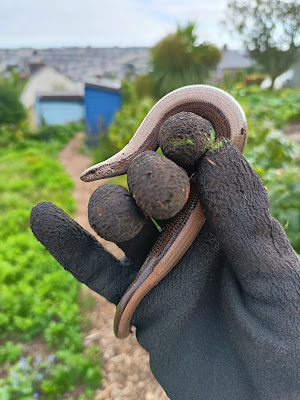
Slow Worm!

Image
Yesterday, on our allotment plot, I worked on completing the rather mundane task of topping up our access paths with woodchips. The Council's tree surgeons very kindly dump piles of the stuff at the top of the site, so my job involved hauling endless wheelbarrow loads back and forth. Good exercise. While filling my barrow yet again, my heart suddenly skipped a beat when I uncovered the beauty pictured above, not out of fear but elation and wonder.  A slow worm! Although alone, this burst from my lips all the same.  I haven't seen a slow worm in years. Interestingly, their Latin name of Anguis fragilis translates as ' fragile snake ', but they aren't actually snakes (or worms) at all. Misnomers all over the place! Instead, they are legless lizards . Unlike snakes, and like lizards, slow worms have eyelids . This gives them the ability to close their eyes, which snakes simply can't do. A slow worm can also shed its tail when attacked to provide the predator a di...

Propagating Alpine Strawberries

Image
  It is the time of year again to propagate our alpine strawberries ( Fragaria vesca ). Throughout the summer, these tiny ruby-red gems burst with a sour sweetness far more flavoursome than full sized garden strawberries. I know this is a stroke of good luck, however, because the same can't be said of all alpine or wild strawberries. Many look luscious, but taste of little more than watery nothingness, from personal experience.  I know you're now anxious to know what variety I grow. Unfortunately, I'm at a loss to tell you. The single little plant I originally bought was sold simply as an alpine strawberry. This is interesting in itself, however, because alpine strawberries are not known for producing runners . These ones definitely do. Just take a look at this tangle.  All those new little daughters are still attached to their mother plants by runners, also called stolons , that act a lot like umbilical cords.  The fact these plants produce such exuberant runners ha...

First Kordia Cherry

Image
Here is a funny little success story for you today. I'm growing four cherry trees in my garden alongside my apples, plums, medlars, and hazelnuts. I cram them into our tiny urban garden by pruning them into a columnar style . In other words, straight upwards, just like Nelson's Column. These trees are still young, so the very first trees to come into fruit are doing so for the very first time this year. When the cherry blossoms bloomed, they were beautiful and raised my spirits after the long winter. Cherries really do flower early.  When little green cherries began developing a few weeks later,  I quietly smiled, pleased they were heading in the right direction. Just look at those little emerald gems.  I refused to get my hopes up though. Young trees usually, and rightfully, drop their fruit to focus instead on strong root and shoot development. My heart quickened when one Kordia cherry , just one fruit, continued to swell and mature from green to red. By the way, this ...

Orchard Grass Management

Image
Here is another little orchard management story, this time about grass. I'm only one person and Plymouth City Council only lets volunteers use hand tools in their community orchards. For health and safety reasons, I don't blame the council. This rule makes complete sense in my mind, but it means I must think very carefully about how best to utilise my limited time. Last year, I bought myself a little hedge clipper (see below), which I used to clip back the grass in little circles just around the trees. Even this conservative approach was a struggle though around all 26 trees. By the time I reached the last tree, the grass around the first one was already tall enough to clip again. This cycle looped around all summer. Not fun...   I noticed something interesting along the way though, something which I initially could not explain. The grass I clipped grew greener and more vigorously than the grass I left unclipped. This occurred consistently around every tree.  Over the winter, ...

The Meadow Maker

Image
Yesterday, I visited the community orchard I maintain in Plymouth's Central Park. One of my previous posts describes it in some detail. While there, it was the orchard's understory rather than trees that caught my attention. Let me rewind a bit to explain.  Last summer, I stumbled across a patch of yellow rattle ( Rhinanthus minor ), on the far side of Central Park from the orchard. They are lovely flowers. I always think they look like a choir of singing parrots pointing their yellow beaks to the heavens. I returned to the spot later in the season to collect some of the dried seed heads. By the way, the species gets its name from the fact its seeds literally rattle inside these heads . I collected the seeds to spread in the orchard, which is exactly what I did. I seeded them into a little patch by cutting the grass short and raking in the seeds to ensure they made good contact with the soil.  I went to all this effort because yellow rattle has the alternate name of meadow ...

Elegant Composting

Image
As I'm sure you can tell from my previous post , composting is a topic close to my heart. So, when I stumbled across the method Joel Salatin and his team use on Polyface Farm in Virginia, USA, I got quite excited. Joel farms grass-fed beef cattle. In winter, he houses his animals inside due to Virginia's harsh weather. Inside the barn is where the magic happens. I've, honestly, never heard of a more elegant composting solution. Essentially, by simply behaving naturally, Joel's livestock breeze through all the heavy lifting.  The process starts with the cattle themselves. They do what cows do best and poo day in and day out inside the barn. Rather than carting the manure away to slurry pits, Joel and his team simply cover it over with woodchips and straw right there on the barn floor. Over the winter months, this pile of poo and carbon grows higher and higher to well over a metre.  By spring, isn't everything buried literally in sh** you might ask? The short answer...